Notebook
Two years in New Zealand
We landed in Tauranga two years ago this month, and I assumed I'd be finished with the moving by now.

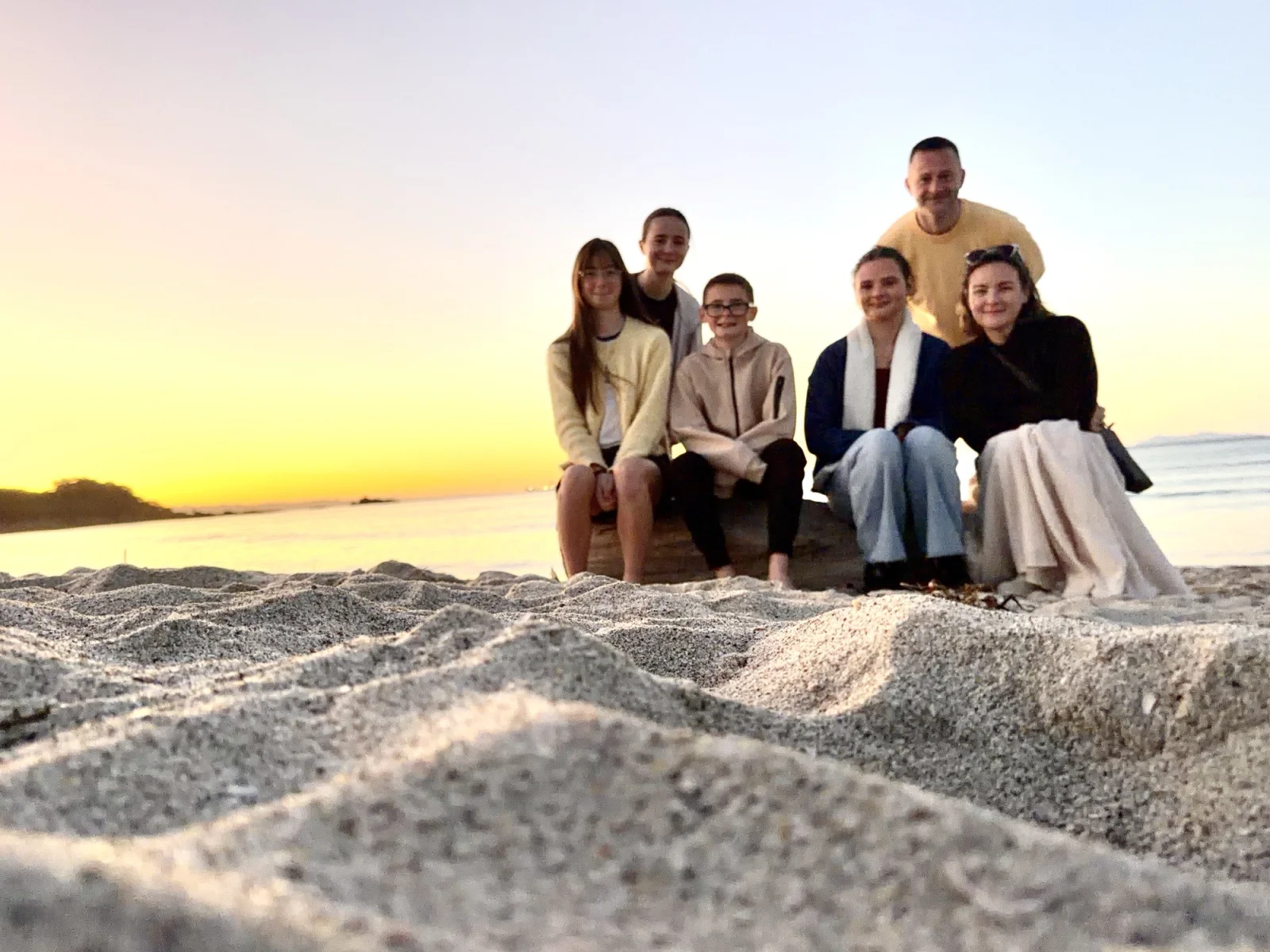
We landed in Tauranga in August 2024. Two years ago this month, which is the sort of milestone that turns up without first checking whether you’re ready for it.
I assumed I’d be finished by now. Not finished with the place, but finished with the moving. I thought two years would be enough to be through it and out the other side, to be a person who lives here rather than a person who moved here. I’m not. That’s the honest report.
I’ve already written about the visa, the costs, the timeline, the house we sold, the schools we found. I’m not going to do any of that again. The striking thing, looking back, is that every item on that list worked. The plan was sound and the plan delivered. The hard part turned out to be somewhere else entirely.
The hard part was never the paperwork
If you’d asked me before we left what I was most worried about, I’d have said money, or schools, or whether the work would hold up. Practical answers, because emigrating presents itself as a practical problem. It has forms and fees and deadlines. It rewards planning, and I’m reasonably good at planning.
What I hadn’t done was look properly at what my social life in Scotland was actually made of. I assumed it was solid, mostly because I’d never had cause to test it. Emigrating is a test.
The pool was always smaller than I thought
Here’s the thing I’ve had to sit with. Even in Scotland, our actual friendship pool was fairly small. Smaller than I’d have claimed if you’d asked me at the time, and considerably smaller than it felt from the inside.
A good deal of what I counted as friendship was proximity. We were close to people because we were repeatedly in the same places, and the places were doing more of the work than I ever gave them credit for.
The last two years have made that fairly plain. Some relationships have stayed deep and have carried across twelve thousand miles without much effort required from either side. Others haven’t. The messages thinned, then stopped, and there was no falling out and no moment anyone could point at.
I don’t think that’s a failing on anyone’s part, mine included. I think it’s information. Take away the proximity and you find out what was underneath it, and in a fair number of cases the honest answer is that the proximity was the thing.
Emigrating didn’t break any of that. It removed the scaffolding and let me see the shape of what had actually been standing there. I’d recommend the exercise to anybody, with the caveat that you can’t undo it once you’ve run it.
It was the acquaintances I missed
The part that genuinely surprised me is that it isn’t the close friendships whose absence I feel most sharply. It’s the layer underneath them.
In Scotland I had a lot of acquaintances I saw regularly. Tech meetups. People I’d bump into and give twenty minutes to. Faces that recurred without either of us ever arranging anything. None of it was deep and none of it needed to be. It kept the social battery topped up in a way I never noticed until it stopped.
When you emigrate you lose the deep relationships and the acquaintance layer at the same time. I’d only budgeted for the first, and it turns out the second was carrying more of the load.
The maths is unforgiving once you set it out. A meetup here, a coffee there, a handful of unplanned conversations across a week. None of it significant on its own, all of it adding up to a background hum of contact with other people. Take the hum away and what remains is a small number of scheduled interactions, and I don’t think anybody is built to run on scheduled interactions alone.
Working on my own compounds it. I don’t have colleagues. There’s no office, no corridor, nobody deciding on a Friday afternoon that we’re all going to the pub. That whole category of incidental contact simply isn’t available to me, and it was never something I had to think about before.
I took a permanent desk at a co-working space, partly for the work and partly in the hope that something would form out of it. It hasn’t, particularly. People are there to work, which is entirely reasonable of them, and beyond the occasional social hang there isn’t a great deal else on offer. Although I gave it about six months, and six months probably isn’t long enough to judge anything.
Coaching Levi’s football team is another avenue, and a better one in that it puts me in the same place with the same people every week. The catch is that coaching means you’re with the boys rather than with the parents on the sideline. You’re present at the thing without being part of the conversation going on ten yards away.
The closest I’ve found to the old arrangement is the Tuesday night football at the local park. Three small-sided games, forty-odd players of every age and nationality, nobody arranging anything with anybody in advance. It’s exactly right for this stage of life, and it’s the one hour in the week that works the way things used to work without my having to engineer it.
Different stages
I’d assumed the barrier would be that Kiwis already have their people, and there’s some truth in that. Plenty of them have had the same mates since primary school. But it isn’t the whole picture, and Tauranga has a lot of immigrant families in more or less our position, so it’s not as though we’re the only ones starting from nothing.
More of it comes down to life stage. Sarah and I are working through exams and starting to think about the older ones heading off to university, and a lot of the families we find ourselves alongside are still in the early years of all that. Nobody is excluding anybody. We’re just running on different clocks, and clocks don’t line up on request.
I had a template in my head that turned out not to apply. In 2010 we came very close to moving to the US, and the friendships there formed almost immediately. Inside a week we had people like the McDades, the Jaegers and the Messengers, and it felt effortless in a way I assumed was simply how it went when you turned up somewhere new.
What I hadn’t factored in is that we were all at the same point back then. Everybody had young kids, everybody’s week looked broadly the same, and that does an enormous amount of the work for you without anyone having to try. We have older kids now. The conditions that made 2010 so easy aren’t the conditions we’re in, and I spent a good while expecting a repeat of something that was partly a product of timing.
So we stay. Redeemer is a solid Bible teaching church and there aren’t many of those in this city. The people are wonderful, and our community group is full of wonderful people too, even if we’re at different points in life there. None of that is in question, and none of it is the thing that’s missing.
We keep turning up as a family, partly because it’s where we belong and partly in the hope, and the prayer, that a family shaped something like ours walks in, sees us there, and decides to call it home too. It may simply be taking longer than we anticipated for things to fall into place. I’d rather be present and waiting than absent and wondering.
Scotland stopped being home in 2003
I should be honest about something, because it complicates the usual emigration story. Scotland hasn’t really felt like home to me since Mum and Dad moved out here in 2003.
Once your parents live on the other side of the world, the place you’re from quietly becomes somewhere you have history rather than somewhere you belong. That shift happened more than twenty years before we got on the plane, so whatever I’ve been feeling these last two years, it isn’t a longing for Scotland.
We’re going back for Christmas this year, which was always the plan. Year two, once we had our feet under us. I’m looking forward to it the way you look forward to seeing people, rather than the way you look forward to going home.
It also means my parents are twenty minutes away instead of twelve thousand miles. I’ve joined Dad’s golf club and we play most weeks, and I was there when he broke a hundred for the first time. Rebecca has taken up the game too. None of that would exist if we’d stayed, and I don’t take a year-round course with no frosty mornings for granted either.
Living here, earning somewhere else
My work is almost entirely with people who aren’t in New Zealand. Calls land early in the morning, which suits me perfectly well, and the shape of my working week is the best it has been. I’ve no complaints on that front at all.
It’s simply the inverse of where we were. In Scotland I was the one waiting for the other side of the world to wake up. Now I’m the one they’re waiting for.
The work itself is the most fulfilling of my career, and I don’t say that lightly. A small team, a four-day week, and products that make a difference to the people using them rather than another commerce platform with a revenue target bolted to it. I had exactly that in Scotland too, and it’s the one part of the old life that made the move intact.
The kids got there first
They call this home. Not sentimentally, not as a decision anyone announced. Just an offhand sentence, dropped mid conversation, the way you’d mention any ordinary fact. I don’t think they noticed saying it. I noticed.
There are absolutely things about Scotland they miss, and they say so. What comes up most is Harvest, our church back in Scotland, and the friendships they had there. But the deeper homesickness I’d braced myself for hasn’t arrived. I still catch myself waiting for it, which probably says more about me than it does about them.
Their friendships are real. Proper mates, birthday parties, sleepovers, the entire apparatus. They rebuilt in about a year what I’m still short of after two, and they’re excelling at school on top of it.
None of that stings. We made this move for them, and watching them land this completely is the whole thing working exactly as intended. It’s awe rather than envy. If I’m slower than they are, that’s fine, and it was always the deal.
We also see far more of them than we ever did in Scotland. Evening walks around the Mount, Sunday afternoons at the beach, evenings in the hot pool that only exists because a family trip to Sydney fell through. Levi has his football, Sarah and Hannah have their pottery club out in Bethlehem, and Rachel has her Friday social at a friend’s church. Everyone has found something of their own, and the six of us are in each other’s company in a way the old life didn’t really allow for. We are unapologetically a fair-weather family, and this country suits us.
We can’t be all things to each other
All of this is as true for Sarah as it is for me, and I don’t want to write it as though I’m the only one in it.
One of the genuine pleasures of the last two years is how much time the two of us have spent together. We both love it. We share the same interests, golf among them, even if she gets out on the course a good deal less often than I manage to.
We celebrate twenty years of marriage in October, and I can say without qualification that we’ve never been closer than we have been these last three years. Whatever else this move has cost, it hasn’t cost us that. If anything it has done the opposite.
But we can’t be all things to one another, and that’s the piece we’re working through at the moment. Saying it plainly feels more useful than pretending otherwise. Two people can be very happy in each other’s company and still both need something wider than that.
I suspect a good number of couples who emigrate end up somewhere similar, leaning on each other harder than they used to because there isn’t anybody else in the immediate vicinity to lean on. It works, up to a point, and as problems go it’s a pleasant one to have. But it isn’t a plan.
So the task for year three is reasonably clear. We need to put ourselves in the situations that build friendships for the long term, and keep putting ourselves there well past the point where it looks like it’s working.
In closing
Two things are true and I’ve stopped trying to reconcile them into one tidy conclusion.
The first is that being settled isn’t the same as belonging, and I confused the two for most of the first year. Getting here was a logistics problem and we solved it comfortably. Becoming of a place isn’t a logistics problem, and there was nothing on the checklist that was ever going to touch it.
The second is that the kids are the answer. Whatever this has cost me, and it has mostly cost me a social life I hadn’t properly understood I had, I’d pay it again for what it has given them. They’re home. I’m still arriving, and I find I’m not especially troubled by that.
What I got wrong, sitting in that Starbucks telling Sarah we had a route in, wasn’t the decision. The decision was right and I’d make it again tomorrow. What I got wrong was the timescale. I thought a year, maybe eighteen months, and we’d be through it. Two years in, my honest estimate is that this is a decade-long project and we’re somewhere near the start of it.
So we keep turning up. To church, to the golf club, to the sideline on a Saturday morning, to the park on a Tuesday night, and back to the co-working desk for another go at it. Not because it’s working quickly, but because this is how it works. Slowly, in the ordinary places, a week at a time.